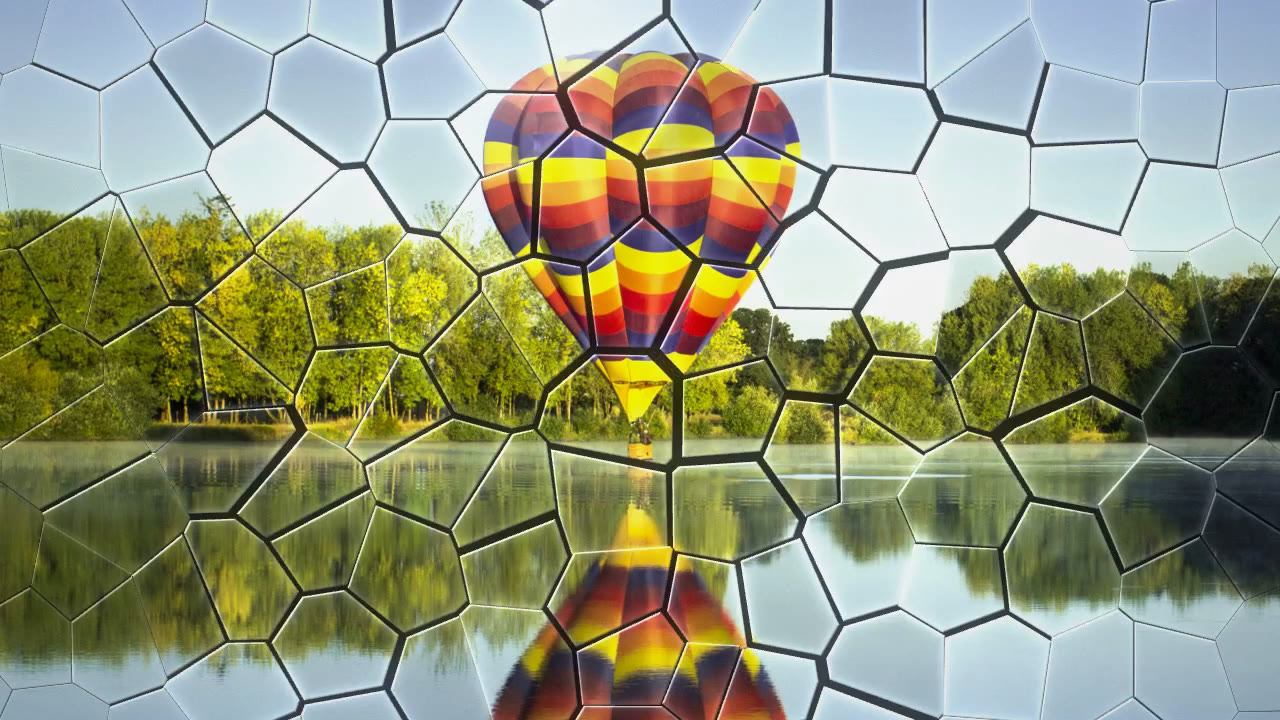
Glass Shatter
Your photo or video is a pane of glass that breaks with the music. Hairline cracks run across the picture, every hit knocks the shards apart to show lit edges and dark gaps, and on a drop the whole picture blows apart and comes back together.
Preview free in your browser · No subscription · Pay only when you export · No watermark
Demo videos
Every demo is a real render of this template. Start from one to get exactly this look.
No demo videos yet — try the template with your own track.
About this template
Shape and layout
The whole frame is your picture, cut into shards: irregular glass pieces, triangular facets, or a broken mirror with cracks running out from an impact point. At rest the picture is whole and only hairline cracks show. Each shard is a real piece of glass that shifts, sinks back and tilts on its own, so gaps open between neighbours and the pieces pass over each other.
Motion
Every shard listens to its own slice of the spectrum — bass at the centre of the break, treble towards the edges — so the picture breaks where the music is. Drum hits travel outwards as a ripple, louder passages open the cracks wider, and each shard eases back into place. Before a drop the glass trembles; on the drop the picture blows apart and reassembles over one bar.
Look and colour
The glass keeps your picture's own colours. Opening shards show a bright bevelled edge towards the light and a shaded one away from it, glints flash as they tilt, and a soft glow in a colour of your choice runs along the cracks. The gaps can be dark, show a dim blurred copy of the picture behind the glass, or leak coloured light from a lamp behind it.
What you can customize
Every setting below is yours to change in the editor, with the live preview updating as the track plays.
Visualizer
- Shard style
- How the picture is cut: irregular glass shards, triangular facets, or a broken mirror with cracks running out from an impact point.
- Glass shardsTrianglesBroken mirror
- Shards
- About how many pieces the picture is cut into. More pieces make a finer break.
- Pattern seed
- Where the cracks run. Every number is a different, repeatable pattern.
- Separation
- How far a shard shifts away from its place on a hit.
- Tilt
- How far the shards tip over on a hit, which is also what makes them catch the light.
- Depth
- How far the shards sink back on a hit; deeper shards open wider gaps.
- Reflection shift
- How far the picture slides inside a mirror shard as it tilts, the way a reflection moves.
- Crack lines
- How dark the hairline cracks are while the picture is whole. Zero hides them until the music opens them.
- Edge light
- How brightly the edges of the shards catch the light as they open.
- Crack glow
- A glow along the edges of each shard that swells with its own part of the music.
- Glow color
- The colour of the crack glow, the lit edges and the light behind the glass.
- Gap color
- The colour between the shards when they open.
- Picture in the gaps
- Shows a dim, soft copy of the picture between the shards, as if the glass hung in front of it. Zero leaves only the gap colour.
- Light behind the glass
- A lamp behind the pane in the glow colour: its light leaks through the cracks and grows with the loudness. Zero switches it off.
- Glints
- Bright flashes when a tilting shard catches the light.
- Drop burst
- How far the picture blows apart on a drop in the track, before it comes back together over one bar. Zero keeps it whole.
- Bloom
- How far the light of the glass edges spills into the picture around them. Zero switches it off.
- Audio reactivity
- How strongly the visualizer moves with the music — lower for calmer motion, higher for a punchier response.
- Transient punch
- How hard drum hits knock the shards apart.
- Frequency layout
- Where the low frequencies sit: at the centre of the break, running left to right, or at the edges of the frame.
- Bass in the centreBass on the leftBass at the edges
- Kick ripple
- How long a drum hit takes to travel from the centre of the break to the edges. Zero hits every shard at once.
- Edge width
- How wide the lit and shaded band along each shard's edge is.
- Attack
- How quickly the visualizer responds when the sound gets louder.
- Release
- How quickly the visualizer settles after the sound drops.
- Vignette
- Darkens the edges of the frame.
- Grain
- Adds fine film-like noise over the frame for a textured, less digital look.
Background
- Background photo
- Background video
Backdrop effects
Effects for your photo or video backdrop, shared by every template.
- Zoom pump
- How much the background photo or video zooms in on the bass. Zero keeps it at a fixed size.
- Travel
- How far the background photo or video wanders around the frame as the track plays. Zero holds it still.
- Camera shake
- A short camera shake on every kick — a vibration with a slight roll — plus a low rumble with the level. Zero holds the camera still.
- Shockwave
- Ripple rings spread out from the centre on the kicks and warp the picture as they pass. Zero never fires.
- Lens
- A lens bulge that pumps on the kicks, with a colour fringe in the outer frame that grows with the level.
- Zoom blur
- Radial streaks shoot out from the centre on the kicks, as if the camera rushed in. Zero never streaks.
- Glow pulse
- A soft bloom around the bright parts of the picture that swells on the kicks.
- Light leaks
- Warm patches of light drift slowly over the picture, brighter the louder the music — a film look.
- Light rays
- Shafts of light from the top-left corner, blocked by the darker parts of the picture, brighter with the music and flaring on the kicks. Zero keeps them off.
- Light sweep
- A soft, slanted band of light crosses the picture once a bar — or, without the track’s analysis, on a strong kick every few seconds at most. Zero never sweeps.
- Lens flare
- Long horizontal streaks of bluish light stretch out of the brightest parts of the picture on the kicks, and rest faintly in between. Zero keeps them off.
- Fog
- Slow drifting mist over the picture, thicker toward the bottom and breathing gently with the music. Zero keeps the air clear.
- Particle overlay
- A layer of drifting particles over the picture that brightens with the music.
- OffDustBokehSnowSparksRainFirefliesConfettiBubblesStars
- Particle amount
- How many particles fill the frame.
- Rain on glass
- Raindrops on a pane in front of the picture: small beads, and bigger drops that slide down and bend the picture. Zero keeps the glass dry.
- Echo
- The previous frame lingers, slightly enlarged, so motion leaves trails and the kicks pull you into a tunnel.
- Neon edges
- The picture's own outlines traced in cycling neon colours, brightest on the kicks.
- Glitch
- Digital bursts on the kicks: sliced rows jump sideways, blocks freeze and the colour channels split. Zero never fires.
- Pixelate
- The picture breaks into square blocks on the kicks and sharpens again within a quarter of a second. Zero keeps it sharp.
- Beat pulse
- The picture breathes in time with the music, swelling and glowing just before each beat so it lands on it. Needs the track’s analysis.
- Perspective tilt
- Tilts the picture like a card in 3D, swaying slowly with the music and nodding on the kicks, with a light that follows the turn. Zero keeps it face-on.
- Liquid
- The picture ripples like a liquid surface, more strongly the louder the music. Zero keeps it flat.
- Flash
- A short flash toward white on the strongest kicks, at most two per second. Zero never flashes.
- Retro VHS
- Tape look: a gentle wobble, colour bleed, scan lines, noise and a tracking band that rolls through on the beat.
- Old film
- Projector look: flicker, hair scratches, dust, a gentle weave and a sepia lean.
- Backdrop grain
- Adds fine film-like noise over the frame for a textured, less digital look.
- Color grade
- A colour treatment over the whole picture — and the colours of the built-in backdrop when you set no photo or video.
- NaturalWarmCoolMonoFaded
- Duotone
- Maps the picture’s light and shade onto two colours, dark to light. Custom uses the two colours you pick below.
- OffMidnightSunsetForestGoldRoseCustom
- Duotone shadows
- The colour the darkest parts of the picture turn into.
- Duotone highlights
- The colour the brightest parts of the picture turn into.
- Motion follows
- What the camera moves follow — zoom pump, shake, tilt, shockwave, lens, zoom blur, liquid, depth, subject pop and focus. A stem needs the track’s stems.
- Whole mixDrumsBassVocals
- Light follows
- What the light follows — glow, flashes, light leaks, rays, sweep, lens flare, fog, vignette, spotlight, rim light and hue steps. A stem needs the track’s stems.
- Whole mixDrumsBassVocals
- Texture follows
- What the texture effects follow — glitch, pixelate, VHS, echo trails, neon edges, particles, rain on glass and subject ghost trails. A stem needs the track’s stems.
- Whole mixDrumsBassVocals
- Drop
- The picture tightens, dims and drains of colour over the bars before a drop, then bursts open on it. Needs the track’s analysis.
- Follow the song
- Calmer reactions in the quiet parts of the song and bigger ones in the loud parts, easing at each change. Needs the track’s analysis.
- Hue drift
- The colours slowly cycle around the hue wheel and take a step on every kick. Zero keeps them as they are.
- Depth parallax
- Sways the near parts of the photo more than the far ones, and swells them on the kicks, so a flat picture gains depth. Needs the photo's depth map: off until it is ready, and on a video.
- Focus rack
- Blurs by depth like a lens: at rest the near part is sharp and the far part soft, and the focus pulls to the background and back on the kicks. Needs the photo's depth map; off until it is ready.
- Depth fog
- A pale haze over the far parts of the picture that breathes with the music, so the near parts stand out. Needs the photo's depth map; off until it is ready.
- Keep subject crisp
- Keeps the photo's subject untouched while blur, glow, echo, tape, grade and grain go to the background only. Needs the photo's subject map; off until it is ready.
- Subject rim light
- A neon rim of light hugging the photo's subject, with a soft halo behind it, flaring on the kicks. Needs the photo's subject map; off until it is ready, and on a video.
- Subject ghost trails
- Pale copies of the subject linger and drift outward with the music while the background stays put. Needs the photo's subject map; off until it is ready, and on a video.
- Subject pop
- The photo's subject swells toward the viewer on the kicks while the background holds still. Needs the photo's subject map; off until it is ready, and on a video.
- Subject spotlight
- Darkens the picture around the subject, like a spotlight that follows it and breathes with the music. Needs the photo's subject map; off until it is ready, and on a video.
- Beat sync
- Lands the stepping effects — the kaleidoscope, the hue drift and the shockwave rings — on the beat or the bar instead of on every bass hit. Needs the track’s analysis.
- OffEvery beatEvery bar
- Focus pulse
- The picture softens and dims as the music settles and snaps sharp and bright on the hits. Zero keeps it steady.
- Vignette pulse
- Mirror
- Folds the picture into mirrored copies. The kaleidoscope turns slowly and steps on the kicks.
- OffLeft-rightFour-wayKaleidoscope
- Particles behind subject
- Spreads the particles through the scene's depth, so some pass behind the photo's subject. Needs the photo's depth map; off until it is ready, and on a video.
- NoYes